Pompeii
TicketLens lets you:
Search multiple websites at onceand find the best offers.
Find tickets, last minuteon many sites, with one search.
Book at the lowest price!Save time & money by comparing rates.
Pompeii is the site of one of Europe’s most famous natural disasters. It was a thriving Roman town when Mount Vesuvius erupted in 79 AD, covering the town and its inhabitants with ash that hid and preserved them for centuries. The archaeological site has been extremely important for historians who want to understand the daily life of Italian from the Roman Empire, and it’s also hugely popular with tourists! Book a trip with an expert guide to get the inside scoop on Pompeii when you visit.
Select a date to find available tickets, tours & activities:
Tickets
Compare admission tickets and check which areas and extras are included in your chosen option.Pompeii Skip-the-Line Tickets with Physical Guidebook
4.9(13246)
headout.com
Go to offer
Pompeii Skip-the-Line Guided Tour with an Archaeologist
4.7(4635)
headout.com
Go to offer
Pompeii: 2-Hour Archaeologist-Led Tour with Priority Tickets
4.5(2478)
getyourguide.com
Go to offer
Pompeii: Entry Ticket and Guided Tour with an Archaeologist
4.8(24323)
getyourguide.com
Go to offer
See all Tickets
Day Trips
Discover day trips featuring this attraction. Check the departure point, transport and admission included in your chosen option.From Rome: Pompeii Day Trip with Optional Vesuvius and Lunch
4.6(12436)
Go to offer
From Naples: Amalfi Coast and Pompeii - Full Experience Tour
4.7(3317)
getyourguide.com
Go to offer
All-Inclusive Pompeii & Vesuvius: Lunch & Wine from Naples
4.6(2798)
getyourguide.com
Go to offer
Pompeii Guided Day Trip with Fast-Track Entry - from Naples
4.5(5761)
getyourguide.com
Go to offer
See all Day Trips
More Tickets & Tours
Explore more experiences related to this attraction and check what each offer includes.Pompeii: Small Group Tour with an Archaeologist
4.8(14275)
getyourguide.com
Go to offer
Pompeii 3-hour Villa of Mysteries tour with an Archaeologist
4.8(1281)
getyourguide.com
Go to offer
Pompeii: Private Family Tour with an Archeologist Guide
4.9(259)
getyourguide.com
Go to offer
Pompeii and Herculaneum: Guided Tour with an Archaeologist
5.0(303)
getyourguide.com
Go to offer
See all More Tickets & Tours
5 tips for visiting the Pompeii
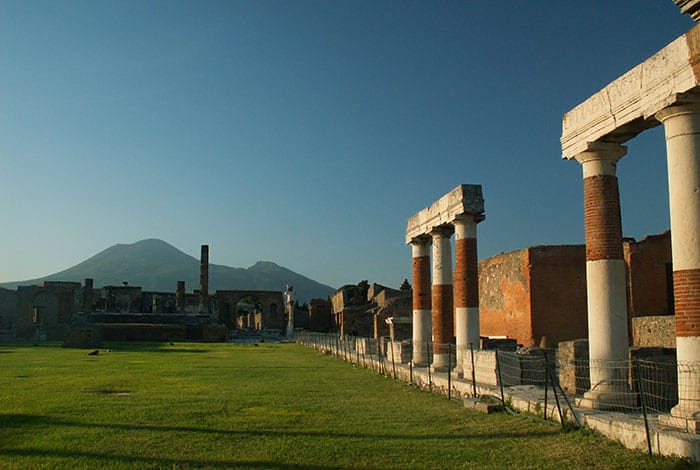 Pompeii | Photo: Hardo Müller CC BY-SA 2.0
1
Make sure to book your tour guide in advance to make sure you have a good experience. It is possible to hire a guide once you get to the site, but make sure they have the appropriate license. Official guides will be carrying an ID badge.
 Pompeii | Photo: Hardo Müller CC BY-SA 2.0
2
The site is exposed to the elements, with limited shade in summer and not many indoor areas in winter. Wear clothes suitable for the weather, and make sure to bring comfortable shoes for walking!
3
Part of the fun of Pompeii is discovering the graffiti that ancient Romans left behind. From ‘Satura was here’ to instructions on how to rent the building it was etched on, to some interesting bragging about who seduced who, it’s interesting to see that humans haven’t changed that much in 2000 years. Find your favorite pieces and take a picture, but don’t add any new notes to the walls!
4
Bring some snacks and plenty of water with you. There are a café and a restaurant within the archaeological site, but as the site gets extremely busy you might not want to spend your time waiting in line.
5
The site is huge and not all of it is open to the public, so stick to the marked paths. Path 1 takes about 2 hours, path 2 takes about 3 hours, and path 5 takes about 5 hours. If you’re visiting with a guide then make sure to take some time to explore by yourself afterward, because they won’t be able to show you everything!
Frequently Asked Questions
What’s so important about Pompeii?
During its heyday, Pompeii was a moderately important town locally, but it didn’t have the same significance as Ostia, for example, or Herculaneum. Estimates suggest that it was home to around 11,000 people, a medium-sized town with a busy industrial port but no particular political or cultural significance. That was until it was destroyed by a volcano in 79 AD, forgotten until its rediscovery in 1738. The town’s preservation under ash, though fatal for the inhabitants, meant that it provided a wealth of material to archaeologists and historians. From preserved buildings and items for sale to the physical remains of the people who died in the eruption (including their clothing and skeletons), historians have been able to piece together what life might have been like for an average citizen of the Roman Empire. It’s been an invaluable resource, so much so that schoolchildren are taught about Pompeii all around the world and that there have been near-continuous excavations going on at Pompeii for over 250 years.
Read more.What’s there to see at the archaeological site?
The archaeological site of Pompeii is huge and there’s a lot to see. The shortest route takes you past a set of Roman baths, the Sanctuary of Apollo, the Temple of Jupiter, and several houses which are notable for their content or decoration, including the House of the Tragic Poet and the House of the Geometric Mosaics. The House of the Tragic Poet is famous for its mosaic containing one of the first ‘Beware of the Dog’ signs - ‘Cave Canem’. You can see bakeries with intact ovens, private homes with surviving wall paintings, two theaters, gladiators’ barracks, and many other buildings which you’d expect to find in a well-off city in the Roman Empire.
Read more.Should we take a guided tour?
Yes! There are some signs throughout the site, but the best way to make the ruins come to life is to take a walking tour with an expert guide. They’ll be able to show you the small details you might otherwise miss, like ancient graffiti or small items inside houses which show you who lived there or what the room was used for. If you’re not planning to take a guided tour then you should definitely bring or buy a guide book which will give you some extra information.
Read more.How long should we plan for our trip?
You should plan at least 2 to 3 hours for exploring the archaeological site of Pompeii. If you’re intending to take a day trip from either Rome or Naples then it’s likely to take the whole day, but you may be able to combine the trip to Pompeii with a trip to either Vesuvius or another archaeological site. If you’re fascinated by Ancient Rome and want to explore thoroughly then you might need to spend more than one day exploring not only Pompeii but the nearby sites of Oplontis, the Antiquarium of Boscoreale, the Stabiae Ruins, Villa Ariana, and Villa San Marco.
Read more.Is the archaeological site accessible?
The entire archaeological site is not accessible, but there has recently been work done to ensure that visitors with mobility problems or other needs are catered for. There is a 3.5km itinerary called ‘Pompeii for All” which is designed to allow visitors in wheelchairs or parents using strollers to access the most important buildings in comfort. Visitors intending to use this route should enter via the Piazza Anfiteatro entrance. Wheelchair users may need to bring a companion as some ramps may have a greater than 8% incline, and some areas of paving are still uneven. Guided tours in Italian Sign Language (LIS) are also available for Deaf and hard of hearing visitors.
Read more.General information
opening hours
From 15 October to 15 March: open 9:00 am–5:00 pm, with last admission at 3:30 pm. From 16 March to 14 October: open 9:00 am–7:00 pm, with last admission at 5:30 pm. Entry bands are 9:00 am–1:00 pm and 1:01 pm–3:30 pm in winter, and 9:00 am–1:00 pm and 1:01 pm–5:30 pm in summer; daily admission is capped at 20,000. The site is closed on 25 December and 1 January unless otherwise announced. In 2026, evening openings run 7:30–11:30 pm, with last admission at 10:30 pm, on 29 August; 5, 12, 19, and 26 September; and 10 October. Individual buildings may close earlier or have temporary access restrictions.
address
Pompeii, Porta Marina Entrance
Via Marina 6
80045 Pompei, NA
Via Marina 6
80045 Pompei, NA
website
Official site: http://pompeiisites.org/
tickets
2026 admission prices (effective from 12 January):
Ancient city of Pompeii (single entry):
- Adults: €20
- EU citizens aged 18–24: €2
- Under 18: free
Pompeii including suburban villas (Pompeii+) + Villa Regina in Boscoreale with Antiquarium and shuttle (single entry):
- Adults: €25
- EU citizens aged 18–24: €2
- Under 18: free
Pompeii Plus multi-site package (Pompeii Plus + Oplontis + Villa Arianna + Villa San Marco + Archaeological Museum of Stabiae + Boscoreale + shuttle; 3 days, one entry per site):
- Adults: €30
- EU citizens aged 18–24: €2
- Under 18: free
Single-entry tickets do not permit exit and re-entry. Pompeii Express holders can add the Suburban Villas route for €8, payable by card only at the route entrance. Admission is free for all on the first Sunday of each month and other designated free days; online booking is unavailable on those days. On the listed 2026 evening-opening dates, each Pompeii itinerary costs €7.
Ancient city of Pompeii (single entry):
- Adults: €20
- EU citizens aged 18–24: €2
- Under 18: free
Pompeii including suburban villas (Pompeii+) + Villa Regina in Boscoreale with Antiquarium and shuttle (single entry):
- Adults: €25
- EU citizens aged 18–24: €2
- Under 18: free
Pompeii Plus multi-site package (Pompeii Plus + Oplontis + Villa Arianna + Villa San Marco + Archaeological Museum of Stabiae + Boscoreale + shuttle; 3 days, one entry per site):
- Adults: €30
- EU citizens aged 18–24: €2
- Under 18: free
Single-entry tickets do not permit exit and re-entry. Pompeii Express holders can add the Suburban Villas route for €8, payable by card only at the route entrance. Admission is free for all on the first Sunday of each month and other designated free days; online booking is unavailable on those days. On the listed 2026 evening-opening dates, each Pompeii itinerary costs €7.
how to get there
The entrance at Porta Marina can be reached via Circumvesuviana trains from Naples to Pompei Villa dei Misteri, while the Piazza Anfiteatro can be reached by Circumvesuviana trains that stop at Pompei Santuario. The site can also be reached by Ferrovie dello Stato Italiane trains to Pompeii station. The site can also be reached by SITA bus services from Naples and Salerno, or by BusItalia routes 4 and 50 from Salerno. There is no on-site car parking, but there are municipal and private car parks nearby where drivers can park for a fee.
How useful was this page?
Average rating 4.2 / 5. Vote count: 5.
Compare prices for more top sights in Naples:
Royal Palace of Naples7 tickets & guided tours
Naples National Archaeological Museum18 tickets & guided tours
Museo di Capodimonte5 tickets & guided tours
Capri Island109 tickets & guided tours
Spanish Quarters25 tickets & guided tours
Museum of the Treasure of San Gennaro5 tickets & guided tours
Popular attractions
Knossos ticketsLa Scala ticketsHarry Potter: Warner Bros Studios tickets25 de Abril Bridge ticketsNeuschwanstein Castle ticketsBerggruen Museum ticketsFort St Angelo ticketsSeaWorld San Diego ticketsOne World Trade Center ticketsEiffel Tower ticketsBurj Khalifa ticketsMilan Cathedral ticketsGuinness Storehouse ticketsLast Supper - Santa Maria delle Grazie ticketsMoulin Rouge ticketsGardens by the Bay ticketsStratosphere Tower ticketsDisneyland Paris ticketsDohány Street Synagogue tickets
Language
English
Currency© 2020-2026 TicketLens GmbH. All rights reserved. Made with love in Vienna.